
Making money with print on demand takes more than uploading a design and waiting for sales.
The model lets you sell custom products without buying inventory or shipping orders yourself. Your profit still depends on choosing the right audience, creating products people want, pricing carefully and attracting customers.
Start with one audience, one product category and a small collection. Then use real customer behavior to decide what to improve or expand.
New to the business model? Start with our guide to what a print-on-demand side hustle is.
How Does Print on Demand Make Money?
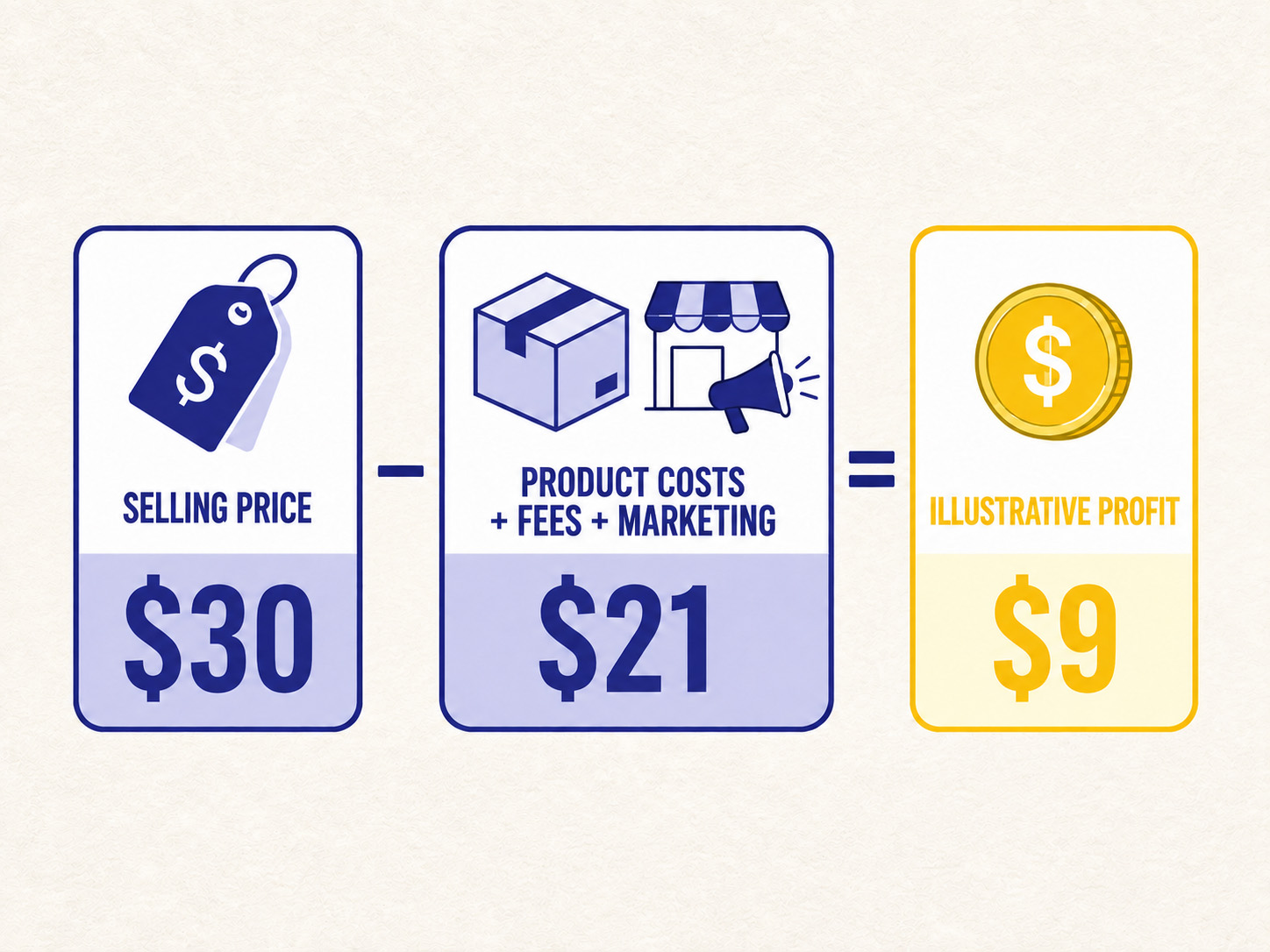
You sell a product at a retail price, while your fulfillment partner charges you for producing and shipping it.
What remains after product costs, platform fees, marketing and other expenses is your profit:
Selling price – product costs – fees – marketing costs = profit
For example, imagine you sell a product for $30. If the product, fulfillment, platform and marketing costs total $21, that leaves an illustrative profit of $9 before any other business expenses.
Your actual margin will depend on the product, selling platform, shipping setup and marketing costs.
The goal is not simply to charge more. Customers still need to believe the product is worth the price.
1. Choose a Specific Audience
Products created for “everyone” are usually harder to sell because they do not speak clearly to one type of customer.
Choose an audience based on a hobby, profession, sport, lifestyle, life event or shared sense of humor.
“Fitness clothing” is broad. “Gym shirts for first-time powerlifters” gives you a clearer customer, design direction and marketing message.
A focused audience helps you decide what to sell, which designs will feel relevant and where to promote them. The better you understand the customer, the easier it becomes to create something they may buy.
2. Choose Products With a Clear Reason to Buy
Before adding a product to your store, ask why your target customer would want it.
A product might solve a practical need, celebrate an identity, make someone laugh or work as a gift. Products with a clear purpose are easier to promote than generic items with a design added for no particular reason.
Think about who the product is for, when they might buy it and whether personalization could increase its value. A personalized sign for a new homeowner, for example, has a clear recipient and occasion.
Start with one main product and a small collection. This makes it easier to compare designs and understand what customers respond to.
3. Create Designs People Connect With
A design does not need to be complicated to sell. It needs to feel relevant.
Simple typography, clean graphics and personalized options can work well when they connect with identity, humor, milestones, hobbies or professions.
Avoid copying products that already appear to be selling. Look at what your audience cares about and develop original ideas around those interests.
Make sure you have permission to use every image, phrase, font and graphic in your design. Do not use protected logos, characters, celebrity names or artwork without the appropriate rights.

4. Price for Profit
Pricing is one of the biggest factors in whether your print-on-demand store makes money.
If your price is too low, you may make sales without earning enough. If it is too high, customers may not see enough value.
Before setting a retail price, calculate:
- Product and fulfillment costs
- Shipping
- Marketplace and payment fees
- Advertising costs
- Discounts
- Your target profit
Do not copy a competitor’s price without understanding your own costs. They may have lower expenses, smaller margins or a different business model.
You can increase perceived value through personalization, stronger product images and clearer audience targeting. Customers are not always looking for the cheapest option; they are looking for the product that feels right.
5. Build Listings That Help Customers Buy
A good product can still fail if its listing is unclear.
Your product page should explain what the product is, who it is for, which options are available and how personalization works.
Use titles that reflect what customers may search for. “Personalized Fishing Mug for Dad” is clearer than “Cool Custom Mug.”
Use clean mockups, close-up details and lifestyle images where possible. For personalized products, show an example so customers can picture their own version. Clear listings reduce uncertainty and help shoppers buy.
6. Bring the Right People to Your Store
A product cannot make money if no one sees it.
For beginners, focusing on one or two marketing channels is usually more manageable than trying to be everywhere.
On marketplaces, use relevant keywords in your titles, tags and descriptions. Think about what customers would type into the search bar.
Organic social content can show the finished product, explain who it is for or demonstrate personalization. Simple videos are often enough.
Pinterest may suit visual or gift-focused products, while email can support launches, seasonal collections and repeat purchases.
Paid advertising can expand your reach, but test it carefully. Do not spend heavily on a product that has not shown signs of demand. Start with a manageable budget and increase spending only when the sales and profit figures make sense.
7. Use Seasonal and Gift-Based Demand
Many print-on-demand purchases are connected to occasions such as birthdays, weddings, graduation, Christmas, sports seasons, new homes and retirements.
These moments give customers a reason to purchase now rather than later.
Plan early enough to create the product, order a sample and begin promoting before demand peaks.
Look beyond major holidays. A product for a coach at the end of a sports season may be easier to target than a generic holiday gift.
8. Test Before You Scale
One of the biggest benefits of print on demand is the ability to test products without purchasing bulk inventory.
Instead of launching 50 random designs, release a smaller collection and review what happens.
Track product views, clicks, saves, add-to-cart activity, conversion rate, sales and profit by product.
Do not focus only on revenue. A product with more sales may still be less profitable if its margin is low or its advertising costs are high.
When something performs well, create related versions. You could test new colors, different phrases, personalization, a related product or a seasonal variation.
Scale from evidence, not guesswork.
From working with print-on-demand sellers, we regularly see that focused stores are easier to test and manage than large catalogs of unrelated products. Starting with one audience and one product category makes it easier to understand what is driving interest and sales.

9. Give Customers a Reliable Experience
Making money with print on demand is not only about getting the first sale.
A clear, reliable experience can lead to positive reviews, repeat purchases and recommendations.
Set accurate expectations around product details, sizing, materials, personalization, production times, shipping and returns.
Order samples so you understand what customers will receive and have original products to photograph or film.
Your fulfillment partner also affects product quality, delivery and support.
A platform such as teelaunch can help keep product creation and fulfillment straightforward, with support available when questions come up.
10. Grow What Is Already Working
Once a product consistently attracts attention or sales, build around it.
You could add more designs for the same audience, offer a personalized version, introduce a related product, create a seasonal variation or improve the listing images.
Avoid expanding only to make your catalog look larger.
A smaller collection of strong, related products can be more profitable and easier to manage than hundreds of disconnected listings.
Common Mistakes That Reduce Profit
Choosing a niche only because it looks popular: Popular markets can also be highly competitive. Choose an audience you understand and can create original products for.
Ignoring the full cost of an order: Marketplace fees, payment charges, discounts and advertising can quickly reduce your margin.
Competing only on price: Strong positioning, personalization and a clear reason to buy can be more sustainable than being the cheapest.
Creating too many products too quickly: More listings do not automatically mean more sales. Learn from real customer behavior before expanding.
Spending too much on advertising too soon: Paid ads can amplify a strong product, but they can also waste money on an untested one.
How Much Can You Make With Print on Demand?
There is no fixed amount.
Some sellers generate occasional extra income, while others build larger ecommerce businesses. Results depend on profit per order, sales volume, conversion rate, marketing costs and expenses.
A useful early goal is not to replace your full-time income immediately. It is to prove that you can create a product, attract a customer and make a profitable sale.
Once you can repeat that process, you have something you can build on.
Start With a Simple, Profitable Process
To make money with print on demand, focus on the basics.
Choose a specific audience. Create products with a clear reason to buy. Price them properly. Build helpful listings. Promote them consistently. Then use real results to decide what to improve or expand.
Print on demand removes the need to buy inventory and manage production yourself, but the business still needs a clear strategy.
Start small, keep the process manageable and grow from what works.
teelaunch gives sellers a straightforward way to create products, connect a store and manage fulfillment in one place, with support available as the business develops.
Start creating with teelaunch.
Frequently Asked Questions
Can beginners make money with print on demand?
Yes, but results are not guaranteed. Beginners need to choose a clear audience, understand their costs, create relevant products and consistently promote their store.
How much can you make with print on demand?
There is no fixed amount. Earnings depend on profit per order, sales volume, platform fees, marketing costs and other business expenses.
Which print-on-demand products are most profitable?
The most profitable product is not always the one with the highest selling price. Look for products with manageable costs, room for a healthy margin and a clear reason for your audience to buy.
How long does it take to make money with print on demand?
There is no guaranteed timeline. Some products may attract early sales, while others require changes to the design, listing, pricing or promotion.