
If you’re wondering how to set profitable prices for print on demand, start with one question: After an order is produced, shipped, paid for, and marketed, how many dollars do you keep?
Your selling price needs to cover the product and print, shipping, store fees, marketing, and the occasional order that goes wrong. Once you know those costs, you can set a price that leaves you room to grow.
This guide walks through the calculation using US Etsy and Shopify examples and the teelaunch product prices supplied for this article. The example selling prices and $1 problem allowance are illustrative, so check your own product, variant, and delivery costs before setting a price.
How does print on demand pricing actually work?
With print on demand, you list a product at the price you choose. When someone buys it, your POD provider produces and ships it, and charges you for fulfillment. Your selling channel and payment provider may also charge fees. What’s left contributes to your business costs and profit.
Think in terms of the whole order:
Amount the customer pays − production − supplier shipping − selling and payment fees − marketing − allowance for order problems = amount left from the order.
If you charge the customer separately for shipping, add that charge to the amount they pay. If you offer free shipping, build the shipping cost into your product price. Either way, you still pay the POD provider to ship the order.
Sales tax collected from the buyer is different from money you get to keep. US tax responsibilities depend on where and how you sell, so keep it separate when reviewing your results.
Start with what the product really costs
Check the cost of the specific version you plan to sell. For a T-shirt, that might include the garment, print placement, size, and supplier shipping. A larger size or extra print location can change your cost. For a mug, check both the mug price and shipping; a low product cost can look very different once delivery is added.
Before setting the price, write down:
- Product and printing cost for each variant
- Supplier shipping for one item and any additional items
- Any charge for personalization or extra artwork
- Selling and payment fees on your chosen platform
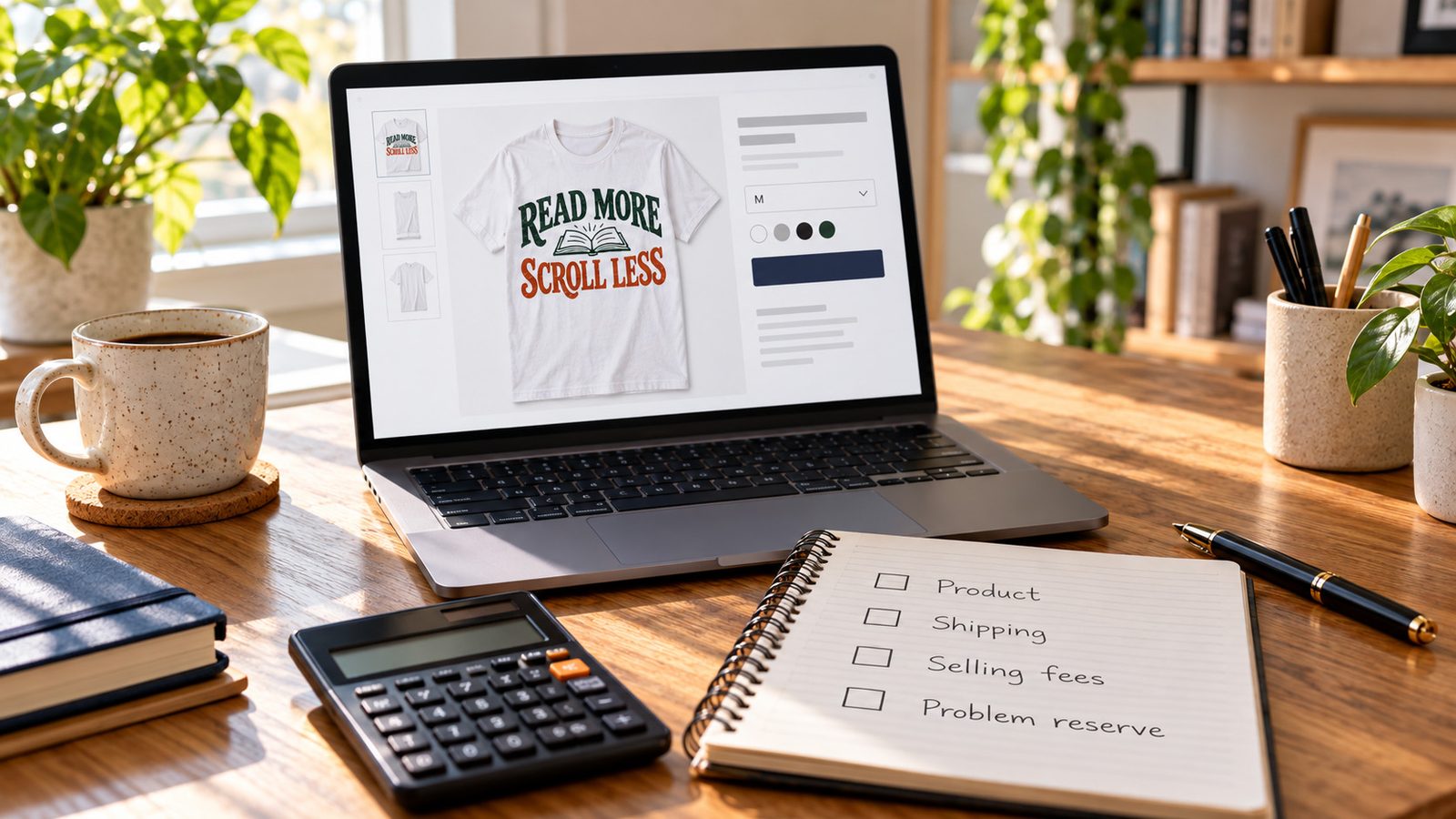
- A small allowance for replacements, refunds, or other order problems
- What you expect to spend to get a sale
If you sell bundles or products that ship from different locations, calculate those orders too. Two products in one cart won’t always produce one low-cost shipment.
What fees should an Etsy or Shopify seller allow for?
For a US Etsy seller using Etsy Payments, the published fees include a $0.20 listing fee, a 6.5% transaction fee, and a 3% + $0.25 payment processing fee. Etsy’s transaction fee applies to shipping you charge the customer, and payment processing also applies to the order total, including charged shipping and applicable sales tax. Listings can incur additional renewal fees. Etsy’s fee guide and payment processing table give the current details.
If an Etsy order is attributed to an Offsite Ad, another fee may apply. Etsy lists 15% for shops below its $10,000 sales threshold and 12% for shops that have reached it, subject to its rules. Check your shop’s status and how often these orders occur. See Etsy’s Offsite Ads rules.
On Shopify, check your plan, payment method, and any apps. For example, Shopify publishes a 2.9% + $0.30 standard online card rate for Basic with Shopify Payments, alongside a monthly subscription. Other payment methods or card types can cost more. Shopify doesn’t supply the customers for your store, so allow for the ads or other marketing you use to bring them in. See Shopify’s US pricing.
A practical print on demand pricing formula
You can start with a selling price and subtract each cost, as in the T-shirt example below. If too little remains, adjust the price and check again. The formula simply works backwards from the dollars you want left.
For one item with free shipping, use:
Starting price = (production + supplier shipping + problem allowance + fixed order fees + target dollars left per order) ÷ (1 − percentage fees)
“Fixed order fees” are set dollar amounts, such as Etsy’s $0.20 listing fee and $0.25 payment fee. “Percentage fees” rise with the amount the customer pays. The problem allowance is money you choose to set aside for the occasional replacement or refund; it isn’t a fee charged on every order. “Target dollars left” still needs to support any marketing or monthly business costs you haven’t included. If you charge for shipping, sell multiple items, or discount the order, calculate against the actual amount the customer pays instead.
Example: price a T-shirt for $8 left per Etsy order
The popular teelaunch Gildan Unisex Shirt costs $9.99 including US shipping for the standard sizes in this example. Larger sizes cost $12.99 including shipping. Because shipping is already included in the shirt cost, you don’t add it again. You set aside $1 per order for problems and want $8 left before any optional advertising or monthly expenses.
For a one-shirt Etsy order with free shipping, the two percentage fees add up to 9.5% (6.5% + 3%). The two fixed fees add up to $0.45 ($0.20 + $0.25). Put those numbers into the formula:
($9.99 + $1 + $0.45 + $8) ÷ (1 − 0.095) = $21.48
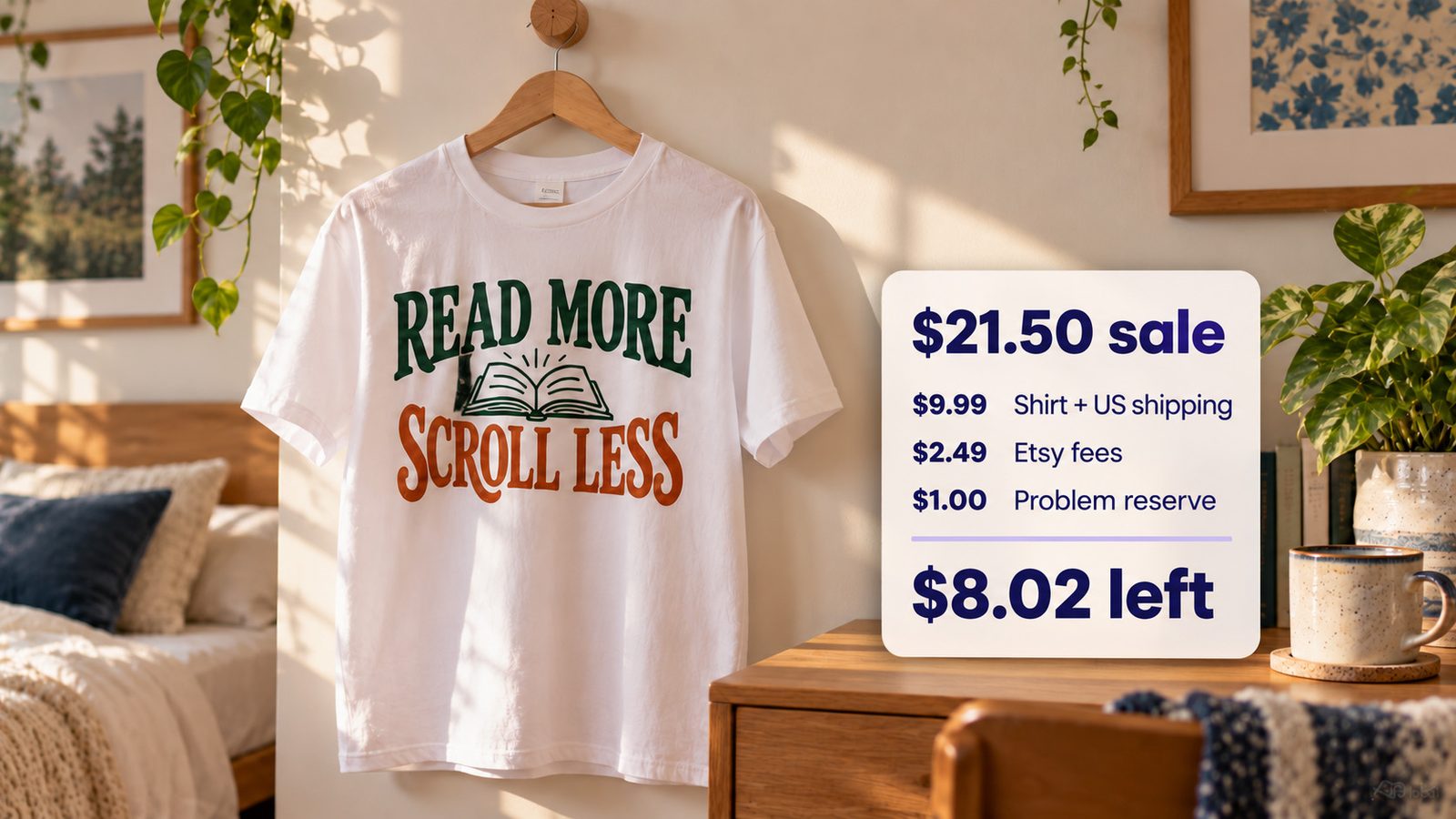
A $21.50 selling price gives you approximately $8.02 left on a standard-size order without ads, assuming no sales tax and no other charges:
| $21.50 Etsy T-shirt order | Amount |
| Customer pays | $21.50 |
| teelaunch shirt, including US shipping | −$9.99 |
| Etsy transaction fee, payment processing, and listing fee | −$2.49 |
| Allowance for problems | −$1.00 |
| Left from the order | $8.02 |
At the same $21.50 selling price, a $12.99 larger size leaves approximately $5.02. Pricing that size at $24.99 would leave approximately $8.18 under the same assumptions. Check variants before applying one price to every size.
That $8.02 isn’t automatically take-home pay. It also has to cover any design time, software, marketing, and other business costs you haven’t assigned to the order.
What happens when you run a sale or an ad?
Keep the same $21.50 standard-size shirt and costs. A 20% discount means the buyer pays $17.20. After the recalculated Etsy fees and $1 allowance, approximately $4.13 remains. If the full-price $21.50 sale attracts a 15% Offsite Ads fee, approximately $4.79 remains. A discounted order that also attracts that 15% fee would leave roughly $1.55.
Before choosing a promotion, decide the minimum dollars you’re willing to keep per order. If your minimum is $5 before advertising, that 20% discount goes too far. A 10% discount on the same shirt would leave approximately $6.07 before advertising. You can then decide whether the sale is worth running, rather than picking a discount percentage because it looks attractive.
Check the whole offer before it goes live: the discounted item price, any free-shipping promotion, and fees that could apply to the same order. If you regularly sell at a discount, use that sale price when judging whether the product works for your store. A promotion should bring in enough worthwhile orders to justify the dollars you give up on each one.
Would the same shirt work on Shopify?
At $21.50, with the same $9.99 teelaunch shirt cost and $1 allowance, Shopify Basic’s illustrated standard online card fee is about $0.92. That leaves approximately $9.59 before advertising and monthly store costs. If it costs $6 in ads to acquire that order, about $3.59 remains before the subscription, apps, and other overhead.
This is why copying one price across channels without checking the costs can mislead you. Run the numbers for each place you sell.
Should you charge for shipping or offer free shipping?
Either can work if the total price covers the order. Here’s a teelaunch 11oz mug example. The mug costs $3.65 and US shipping costs $5.49, bringing the supplier cost for one mug to $9.14. You allow $1 for problems.
On Etsy, listing it at $22 plus $5.49 shipping means the customer pays $27.49. After the $9.14 supplier cost, approximately $3.06 in standard Etsy fees, and the $1 allowance, about $14.29 remains.
List the same mug at $22 with free shipping, and about $9.32 remains. A $27.49 free-shipping price produces approximately the same dollars left as $22 plus $5.49 shipping under these assumptions. Compare what buyers see at checkout, then test the offer that fits your audience. Changing the shipping label alone doesn’t erase the shipping cost or Etsy’s fees on charged shipping.
How do you set profitable prices for print on demand?
Your calculation gives you a starting point. Next, look at products a buyer would genuinely compare with yours. Check the delivered price, garment or material, print quality, personalization options, photos, reviews, and expected delivery time. A distinctive design or useful personalization may give buyers a reason to pay more; a generic listing may struggle at the same price.
If the price needed to reach your target feels too high for the product, try a different product, simplify the offer, improve the design or listing, or reduce a real cost. Don’t assume a thin profit will fix itself when you sell more units.
Before publishing a listing, check your numbers at full price, at your usual sale price, and with your likely marketing cost. Check your most expensive variant as well. Then review actual orders as you sell: what did the customer pay, what did fulfillment cost, what fees appeared, and how much did you keep?
You can start with one product and one clear calculation. Create your product with teelaunch, check its current production and shipping costs, and set a price that works for the way you plan to sell it. You sell. We print. You profit.